
Congratulations @StetsonU Roxanne Lewis (center) for five years of service @StetsonWORLD! #studentadvocate #internationalstudentwarrior #interculturalcompetence pic.twitter.com/g6wj5IfjfV
— BrownCenter@StetsonU (@browncenter_su) April 9, 2019
Sprouting Growth
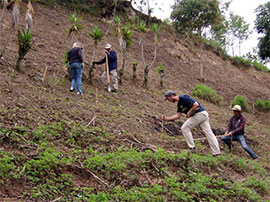
Through the Alliance for International Reforestation Inc. and Stetson, students are planting seeds for learning in Central America.
Since the year 2000, the Alliance for International Reforestation Inc. (AIR) has enjoyed a strong partnership with David and Leighan Rinker, longtime ardent Stetson benefactors, in offering transformational service experiences for Stetson students in Central America.
The partnership actually began when in 1999 David Rinker offered to support student trips with Anne Hallum, Ph.D., a Stetson political science professor and founder of AIR, through the Marshall E. Rinker Sr. Foundation. David Rinker had learned of Hallum’s early experiences working in Guatemala — training farmers in sustainable agriculture and other services — and he wanted students to benefit as well.
Through the years, both literally and figuratively, it’s been quite a journey.
Today, selected students — based on grades, a reflective essay and an interview — participate in three primary programs, along with academic assignments, over a period of four to six weeks. The word participate is used loosely.
Students build stoves with Mayan families and the AIR staff; they are actively engage at rural schools; they plant fast-growing trees on deforested slopes; and they maintain a journal of reflections on friendships made and lessons learned.
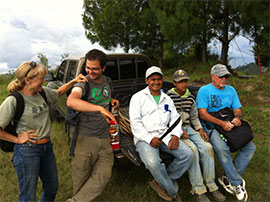
Camaraderie with locals is part of the AIR experience for students.
Over the years, for example, more than 100 stoves have been constructed — involving cement mixing and brick laying — to help prevent lung disease and conserve precious trees. Meanwhile, more than 45,000 fast-growing trees have been planted —up to 4,000 trees each month by hand on mountains — to improve crops and prevent mudslides.
The trips, clearly, aren’t vacations, except for the Saturday “tourist days.”
Last summer, in addition to building and planting, a student with a special interest in marketing shadowed Hallum to learn the nuances of fundraising and donor relations.
The travel expenses for each of those students, as well as for Hallum, are covered by the Marshall E. Rinker Sr. grant (with some funds from Latin American Studies when more students traveled). Those annual grants total approximately $9,000 each June, which cover hotels, food, ground transportation, small stipends and continual supervision by the AIR staff members.
For the students, the payoffs have been significant.
A first-year student was taught the “sheer joy” of an exhausting day of service (especially outdoors). An impressionable 19-year-old who spent six weeks with AIR in Guatemala now is an accomplished alumnus. More generally, AIR has impacted how student view the world.
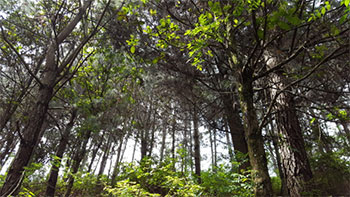
Thanks to charitable funding and Anne Hallum, Ph.D., a former political science professor at Stetson, students continue to participate in uncommon immersion abroad.
Until June 2012, Hallum taught full-time at Stetson and managed AIR’s early growth in Nicaragua and Guatemala. She was able to combine the service work in rural Guatemala and Nicaragua with her own academic research, and to find ways for students to earn academic credits in independent studies such as immersion Spanish, environmental activism, Latin American studies: Mayan Culture, and religion and the environment.
Hallum left Stetson in 2012, moving to Atlanta to work full-time (non-salaried) as president of AIR-Guatemala. Yet, even today, by virtue of her personal ties to the university and the Rinker support, she continues to exclusively host Stetson students for lengthy immersion experiences.
Not coincidentally, in 2017 AIR Guatemala received its second recognition from the United Nations, as a winner of the 2017 Equator Prize, presented by the United Nations Development Programme.
As a result, a reforestation organization founded on the third floor of Elizabeth Hall at Stetson more than 25 years ago now is globally acclaimed. Even greater, it continues to provide uncommon experiences of growth for Stetson students.
-Michael Candelaria
Originally posted at Stetson Today on February 25, 2019
Board of Trustees Presentation: International Learning
by Camilla Morales, ‘20
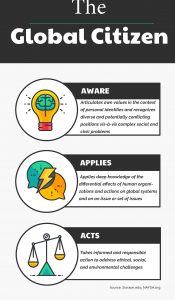
Part of Stetson’s University mission is to promote Global Citizenship by students in order to prepare informed, active, and engaged citizens. On February 14, 2019, I was given the opportunity along with my colleagues, Zoe Weaver, ‘19 and Genicelle Barrington, ‘21, to present our efforts as WORLD Ambassadors to the Academic Affairs Committee of Stetson’s Board of Trustees and along with other faculty and staff members.
The session was opened by Dr. Rosalie A. Richards, associate provost for Faculty Development and professor of chemistry and education, who provided an overview of international learning at Stetson. Board members were then invited to participate in an interactive session, where they visited stations to learn about different aspects of international learning.
There were five different stations: WORLD: The David and Leighan Rinker Center of International Learning at the Deland campus, the Office of International and Graduate Programs at the College of Law in Gulfport, the International Learning Committee, the Latin American & Latino Studies Program, and Student Engagement.
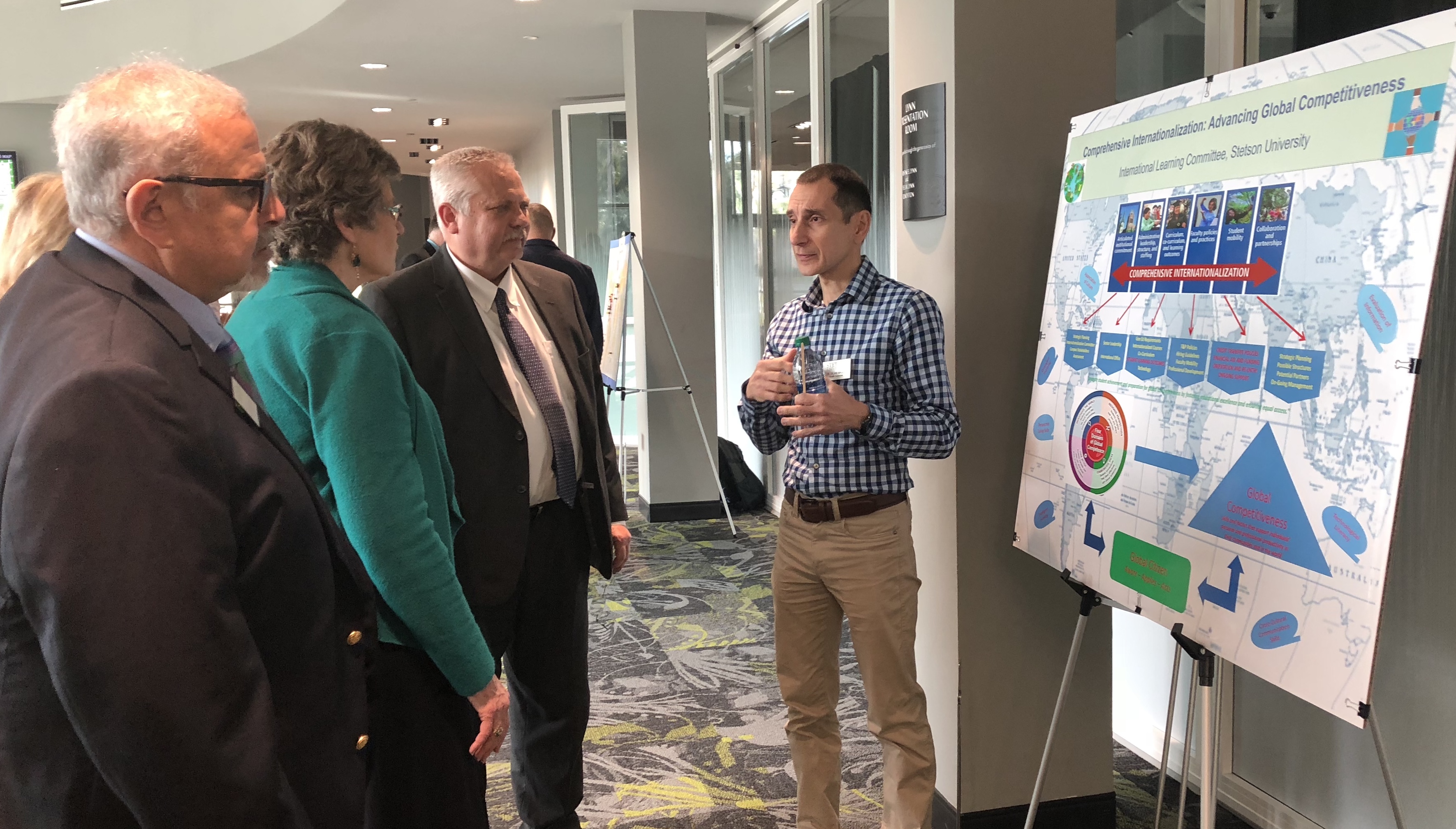
Dejan Magoc, Ph.D. , associate professor of health sciences and chair of the International Learning Committee, describes how Stetson University uses the ACE Comprehensive Internationalization model to advance global competencies.
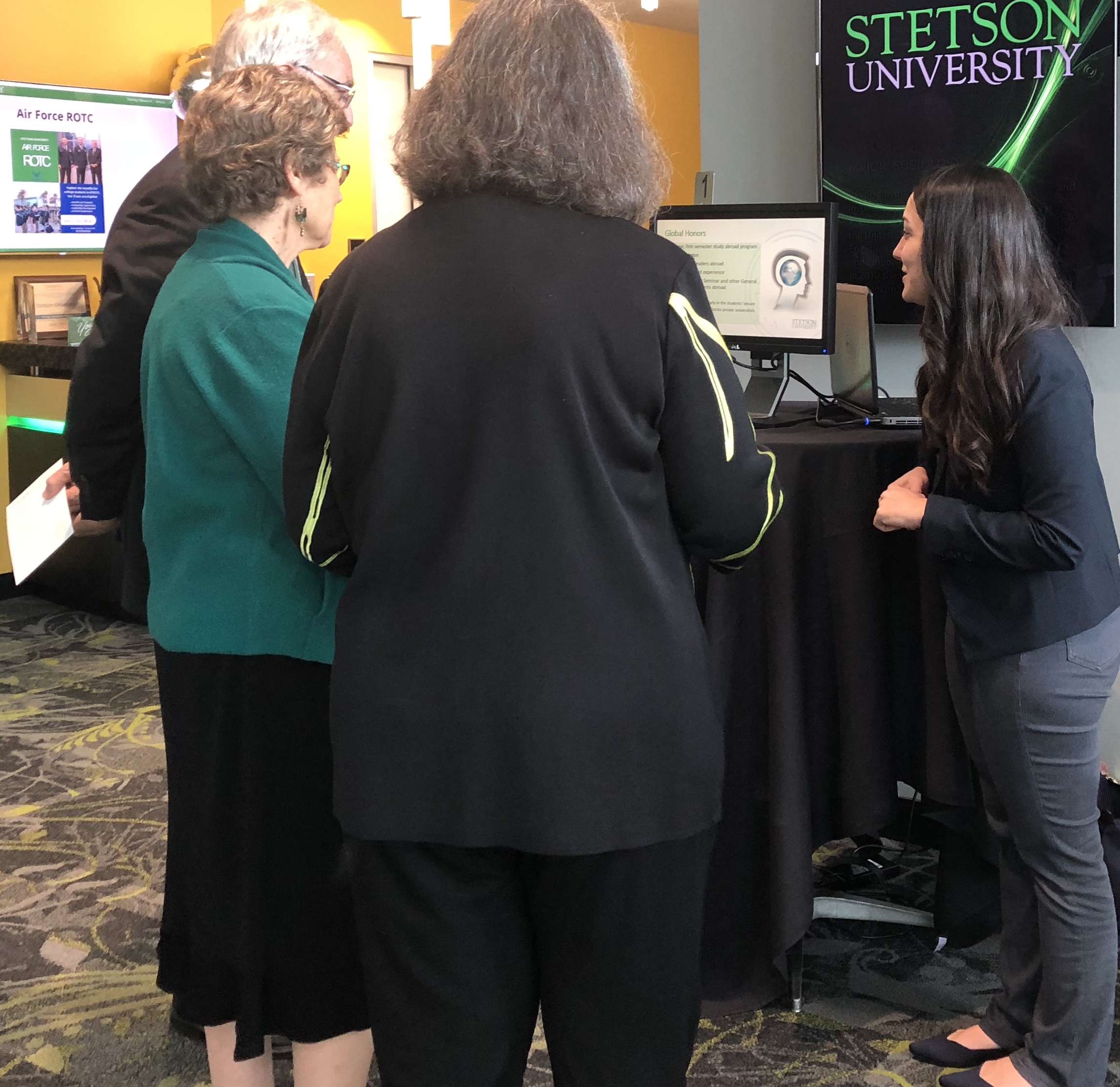
Paula Hentz, M.Ed, director of international learning (right), showcases several new WORLD initiatives.
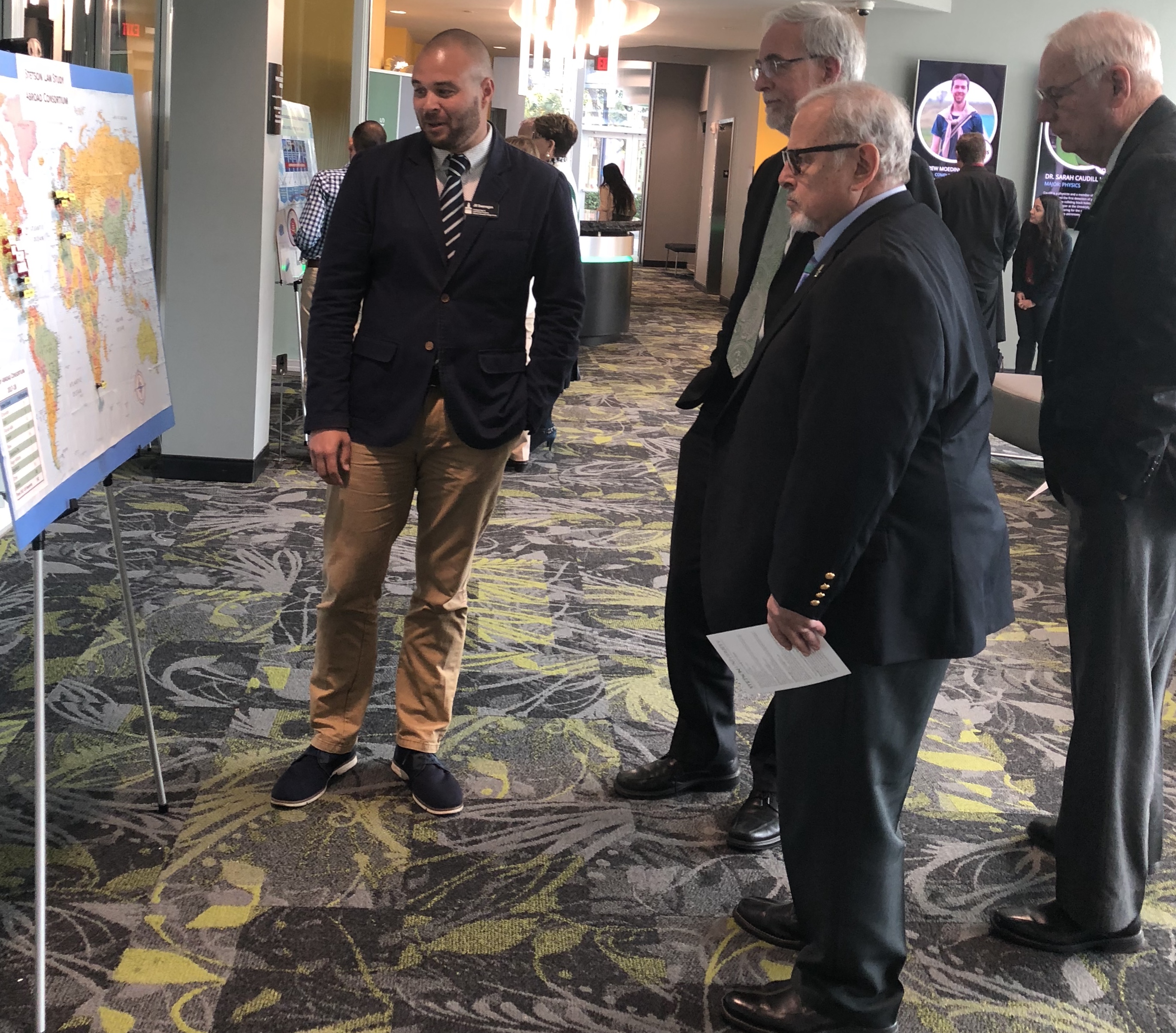
JR Swanegan, J.D., assistant dean of international and graduate studies (left), highlights different consortia developed by the College of Law to advance international learning to Board members including David Rinker, Ph.D., longstanding Trustee and benefactor of WORLD (back).
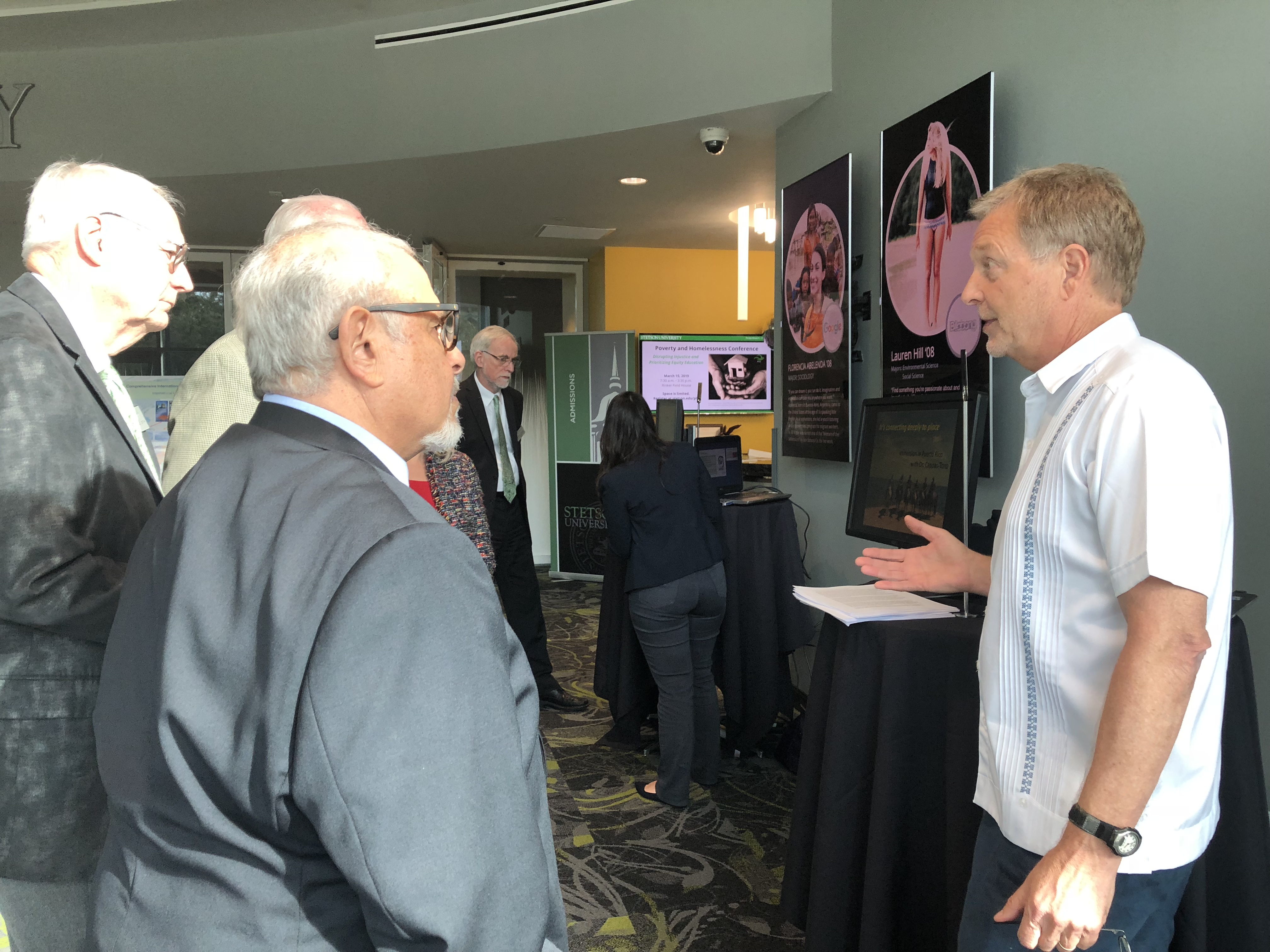
Robert Sitler, Ph.D., professor of world languages and cultures (Spanish) and program coordinator for the Latin American & Latino Studies Program, provides an overview of the program and highlights from the Mentored Field Experience.
My colleagues and I presented at the Student Engagement station and spoke about our roles as WORLD Ambassadors and about our engagement in building global citizenship via international learning. We spoke about several events that we host to promote community engagement, diversity, inclusion and cultural awareness.
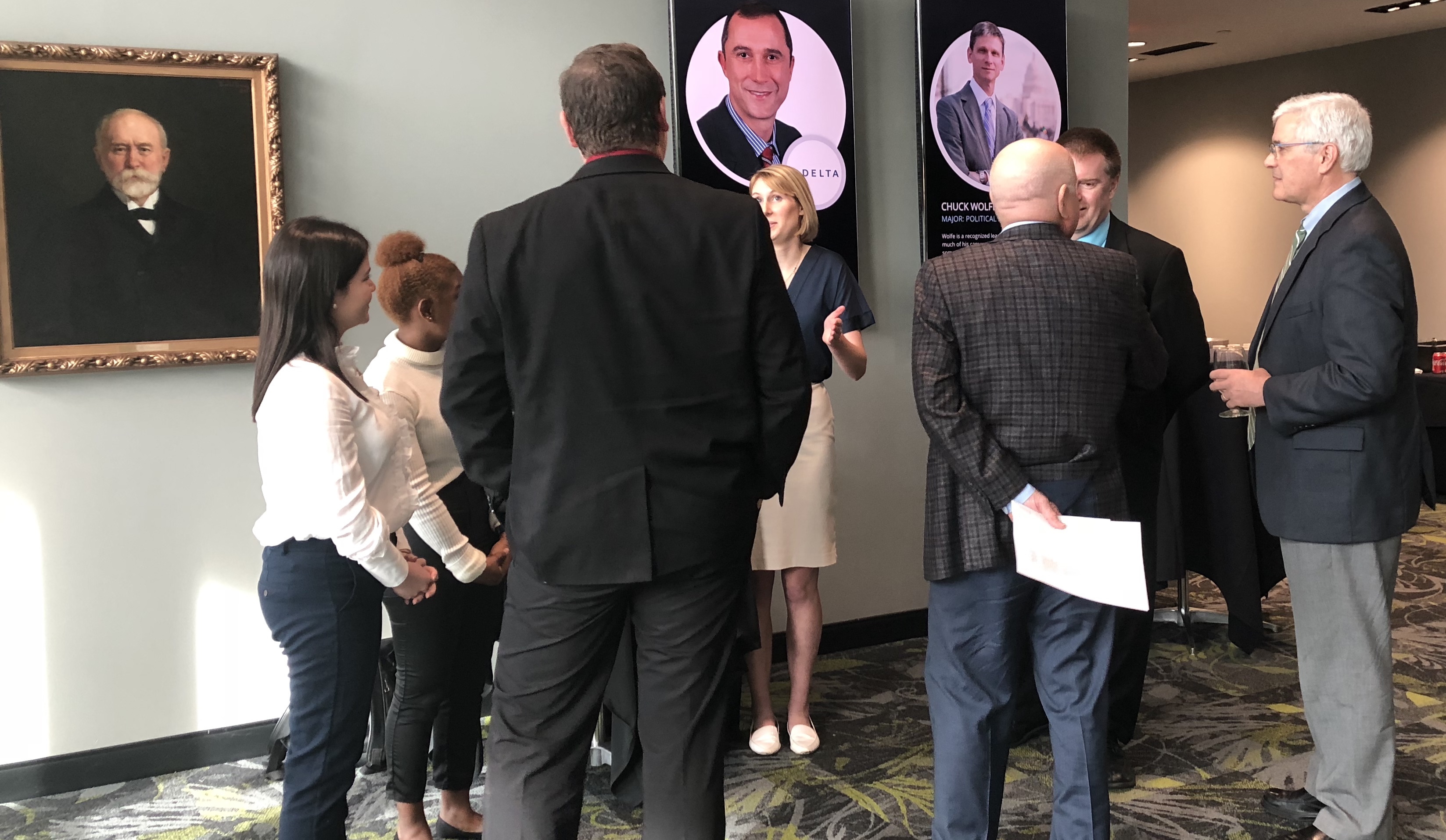
Morales (left) and Barrington (left, white shirt) listen as Weaver (center) discusses study abroad with Board members and senior academic leaders.
The interactive session was followed by a panel discussion where members of the Board were able to ask questions to the presenters.
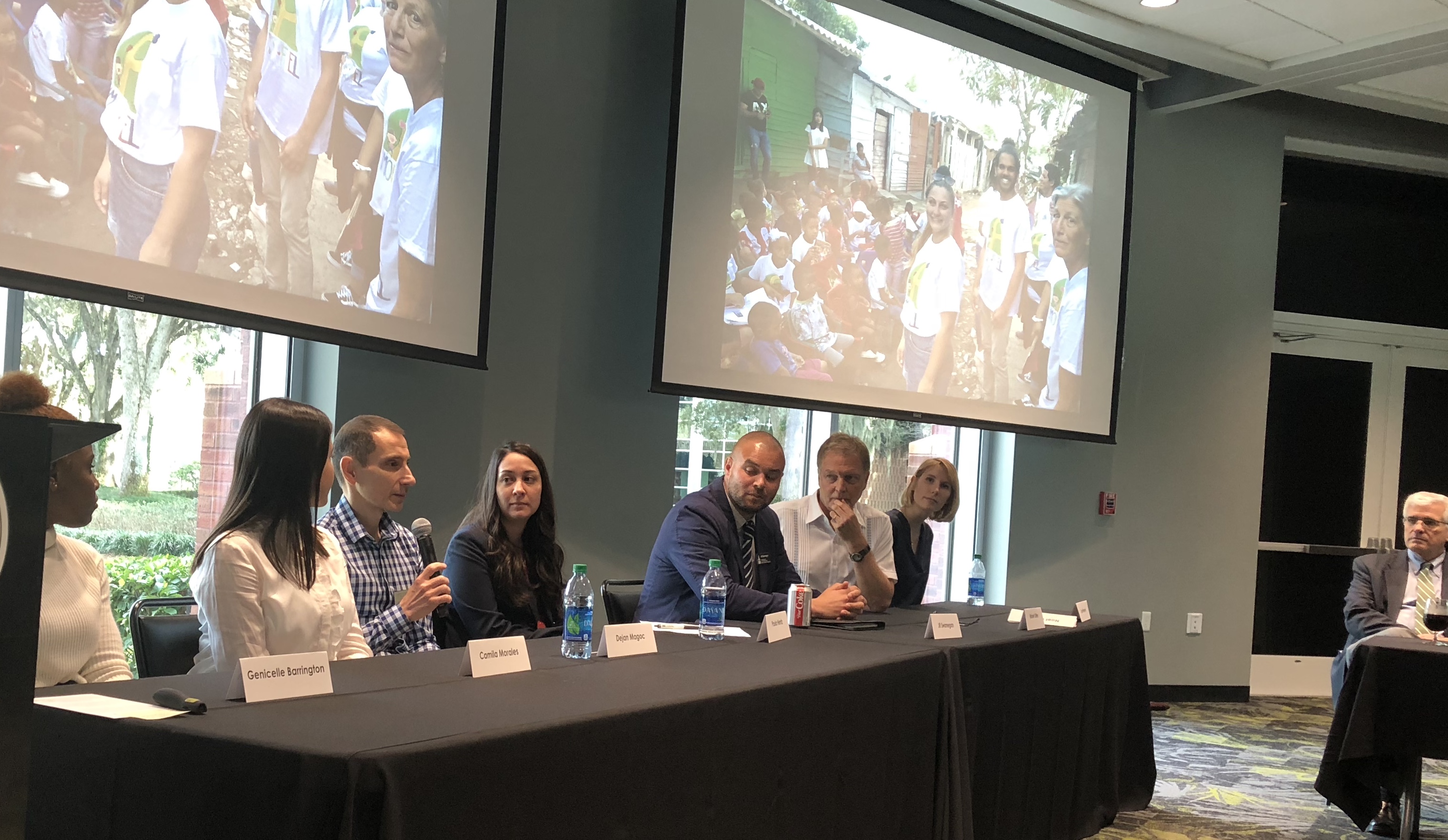
I must say I was very honored to have been asked by my boss, Paula Hentz, director of international learning, to be part of this event along with my colleagues. To be able to talk about a subject I am so passionate about was a great and unique experience. I am eager to see what efforts will be done to keep promoting internationalization at Stetson University.
Adapted from the original story posted on LinkedIn on February 19, 2019
WORLD Director wins “Best Tasting” Pie
Paula Hentz @ StetsonWORLD wins “Best Tasting” for her Triple Chocolate Chunk Pecan Pie @StetsonU Pie Baking Contest #VisitStetson #piebaking pic.twitter.com/BKI0en6vTy
— BrownCenter@StetsonU (@browncenter_su) November 19, 2018
International Student Receives Global Citizenship Scholarship, Stetson Access Grant
Congratulations to Henry Semaganda, international student from Kampala, Uganda, who received one of Stetson’s prestigious Global Citizenship Scholarships. Semaganda has long demonstrated interest in Stetson University, applying twice before receiving the scholarship.
“As a recipient of the prestigious Global Citizen Full Tuition Scholarship, I have an immense opportunity to live my dream at Stetson University, Florida. A dream that has come to pass despite the fact that the competition was indeed stiff, with only one slot available for a student from sub-Saharan Africa.“
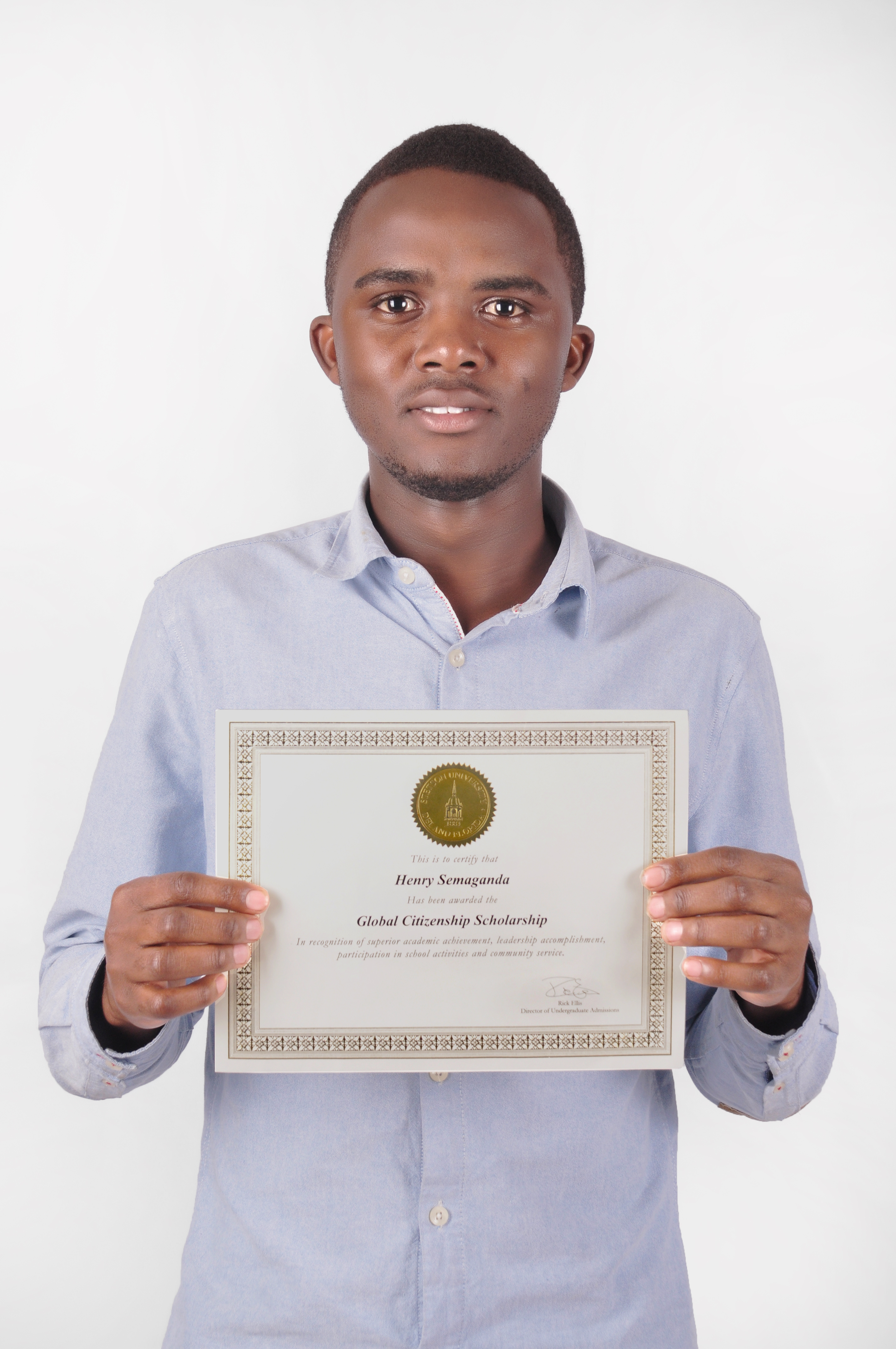 Henry Semaganda, ‘20 (biology), proudly displays his Global Citizenship Scholarship certificate of award. Semaganda is the second recipient of the Global Citizenship Scholarship, a new scholarship program at Stetson University aimed at attracting outstanding international students.
The full tuition scholarship is awarded to incoming international students with top academic potential who exhibit Stetson’s value of global citizenship. Three students are chosen annually, each from different regions of the world. The scholarship enables recipients opportunity to deepen their practice of global citizenship as Semeganda describes in his application essay.
“For a substantial part of my life, I have always held a firm belief in the promise of humanity. This belief has persisted despite the wrongs and misfortunes that have befallen our societies. I have never given up hope in believing that there is potential to do good in all of us and that deep within us lies the solution to the problems that torment the world today ranging from war, terrorism, disease among others. I believe everyone has a place on the team in this journey to make the world a better place for posterity”.
Semaganda has also received the Stetson Access Grant Scholarship (now discontinued) to cover the remaining costs of attending university. He believes that the small class sizes and student-to-teacher ratio at Stetson will afford him the “rare opportunity of an up-close learning experience and mentorship between the professors and me…”
Today, I rejoice in an improbable success. That as a student who began his academic journey at Masajja Bridge nursery and primary school, a school that is on the verge of demolition currently, I will be obtaining my undergraduate education at Stetson University, one of the top institutions in U.S. Both my parents dropped out of school during the 1979 Iddi-Amin civil war but held a firm belief that education would be the ultimate gift they would ever give me. It is their unwavering hope that even pushed me to limits they had never envisioned.
The biology major has participated in the EducationUSA program at the U.S. Embassy in Kampala and has volunteered to work with them to spread the benefits of an American education.
I want to share in the diversity, to bask in the depth, richness and flexibility of an American education. My story is one of hard work, tenacity and unflagging faith that I can be among the best. If one wants to achieve greatness, the door to opportunity is always open. My story has just begun. I urge students from Uganda, and from around the world to never give up on their dreams because they seem too big. Let us strive to push ourselves to limits we have never imagined before.
Semaganda’s future plans include a career as a medical doctor to help improve Uganda’s health system.
“I envision that after my time at Stetson, I will be an ambassador of hope, well equipped with knowledge, exposure and skills to contribute to sensitization and improvement of basic health care in Uganda but more especially in eradicating preventable diseases like HIV/AIDS, cholera and ebola that plague millions of Africans.
”Today, as a global citizen, I long to see African societies that are not held hostage to negative traditional beliefs and senseless stereotypes. This will boost our education, health, infrastructure, relationships, politics and leadership.”
Coming Out against Heckling and Discrimination on the Court
As a Hatter tennis player, Graham Ball sometimes stepped onto the court with added stress and anxiety.
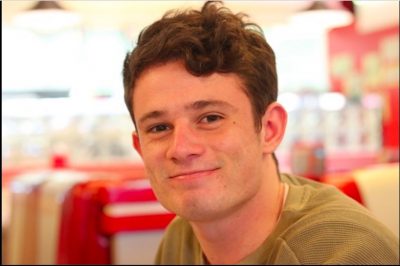
Graham Ball, ’17 Philosophy, wrote a letter urging the NCAA to do more to protect collegiate athletes from heckling and taunting based on their perceived sexual orientation.
He worried fans or other athletes would heckle him during matches and shout out slurs based on how they perceived his sexual orientation. If they did, he would need “an incredible amount of focus” to play his best.
“I was targeted a lot and it was not routine like every match, but it was something I had to worry about,” he said recently. “It was something that was consistently in the back of my mind that caused me stress and anxiety as I was walking on the court to play matches. Okay, how are the fans going to behave? How are my opponents going to behave?”
Before graduating from Stetson University last May, the once-closeted captain of the Men’s Tennis Team decided to speak out. With encouragement from several of his professors in the Philosophy and English departments, as well as officials in Athletics and the Title IX Office, he wrote and asked the NCAA to adopt a “No Tolerance Policy” for heckling and intimidation of character.
“In my cases, I often was the target of harmful comments aimed to induce fear or diminish character based on perceived sexual orientation,” Ball wrote to the NCAA’s Office of Diversity and Inclusion last May. “As a closeted gay student-athlete, these comments bear tremendous weight on my personal life, and I do not believe that they should have a place in any sport etiquette.”
Ball is taking off a gap year at home in Montreal, Quebec, before starting law school. But he has not given up his efforts to create a safer space for athletes. Last month, he wrote an article for Outsports.com about his experiences and outlined his recommendations to the governing body for collegiate sports.
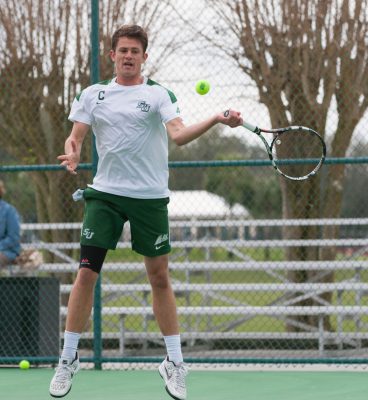
Graham Ball said he has received an outpouring of support from current and former collegiate athletes across America and Canada.
“I do think that the sports world is relatively behind society in terms of speaking out against things like discrimination and slurs. I think my experiences in college, studying philosophy helped me largely to see that,” he said by phone from Canada. “I was exposed to issues of gender, race, sexual orientation, ethics, social justice and I was able to connect that to my life as an athlete. Growing up in tennis, I never really noticed these problems up until college.”
The NCAA opposes discrimination based on sexual orientation or gender identity, as well as race, ability, national origin and religious belief, according to its website.
In a Statement of Affirmation by the NCAA LGBTQ Subcommittee, the association acknowledged that LGBTQ student-athletes, coaches and administrators “too often endure social stigma and emotional trauma on the court, in the classroom, and in the workplace.” But the association said it celebrates their “courage and fortitude” and encourages everyone to speak out against all forms of prejudice.
Ball, in his letter to the NCAA, said the environment at many tennis matches did not reflect the association’s stance against discrimination. “In my view, much more should be done to amend this problem,” he wrote to the NCAA.
Ball recommended the NCAA take a firmer stand against heckling, such as requiring more oversight of the crowd and athletes to prevent taunting based on sexual orientation or gender expression. Ball said more oversight is needed because he sometimes complained about heckling at tennis matches, but the “officials brushed off my concern.”
“I think Graham is a man of character,” said Cathy Downes, Stetson’s executive director and Title IX coordinator. “I applaud his willingness to confront gender and sexual orientation discrimination in a sport he loves, especially understanding the personal risk associated with speaking up. Personal integrity is what allows his voice to resonate through the NCAA.”
Added Stetson Athletics Director Jeff Altier, “In my eyes this is leadership and I am proud that a Stetson education and leadership training from the athletic department, coaches and staff has provided Graham with a foundation that allows him to move his advocacy forward. I applaud Graham for taking a position and for sharing his experience.”
Ball said the letter to the NCAA was “a group effort” at Stetson. He met first with Assistant Professor Melinda Hall and Associate Professor Susan Peppers-Bates in the Philosophy Department, and Visiting Assistant Professor Michele Randall in the English Department. “That’s something I’m incredibly appreciative of because if I hadn’t been supported by the professors I don’t think that I would have had the strength to continue,” Ball added.
He also met with Jeff Altier and PJ Moses, associate athletics director for Student Services, and both were equally as supportive. They helped him craft the letter to the NCAA, along with Downes in Stetson’s Title IX Office.
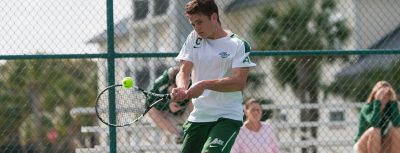
Graham Ball currently is taking a gap year and plans to enroll in law school this fall. He has been volunteering regularly for the West Island LGBTQ2+ Youth Centers in Montreal, teaching adaptive tennis for ProSet Autism, and has spent time working for the Instagram account: @lgbt_history.
“The reason I decided to speak up about this issue in my senior year was following the presidential election, the person who got into office, the climate that was exposed following the election made me realize that I want to contribute as much as possible to give him a counter to what the current norms are,” Ball explained. “I felt that coming out was incredibly important for sharing my story and having my voice heard in a meaningful way.”
Since then, he has been surprised by the outpouring of support from former collegiate athletes and current athletes across the United States and Canada, and as far away as Spain.
Although the NCAA has yet to adopt his recommendations, Ball said he plans to continue his advocacy. He is still deciding on which law school to attend this fall, including possibly Stetson College of Law in Gulfport.
“I will tell you that I have received attention from two tennis companies who are wanting to feature me, too, and want to partner with me on this issue so that’s very promising and we’re going to pursue this to the full extent that we can,” he said.
What is Title IX?
Title IX is a federal law that protects people from gender-based or sex-based harassment, discrimination and violence in an educational institution. Stetson University strives to be a safe place, free from harassment and discrimination of any kind, said Cathy Downes, executive director and Title IX coordinator at Stetson.
The university has people and resources in place to resolve concerns that are reported to the university, and Downes said she wants to assure the Stetson Community that these reports are responded to in a respectful, empathic and effective way.
For more information about Title IX policies, procedures and resources, go to https://www.stetson.edu/other/title-ix/. To report an incident, contact Cathy Downes at 386-822-7960, email [email protected] or go to https://www.stetson.edu/other/title-ix/reporting-options.php.
Students interested in this work can help the Peer Advisory Council for Title IX (PACT) by contacting Downes at [email protected]. Stetson employees can participate in workshops and training like “Safe Zone” training through the Office of Diversity & Inclusion, or “I’m Not Trained for This!” workshops through the Title IX Office.
First reported on March 9, 2018 at Stetson Today by Cory Lancaster
Menayese Named ASUN Player of the Week

Stetson’s Elvis Menayese has been named -ASUN Conference co-Player of the Week, the league office announced on Tuesday. It’s the first career weekly honor for Menayese.
Menayese captures the weekly award after scoring a pair of goals in Stetson’s 3-2 win at FIU last Friday in Miami. The sophomore from Cardiff, Wales, notched the first two goals of his career in the victory as the Hatters picked up their first win of the season.
His first goal gave Stetson a 2-1 lead in the 58th minute and helped the Hatters erase an early 1-0 deficit.
Menayese’s second goal clinched the victory, and he slid past the keeper for an easy score with less than three minutes to play.
The Hatters continue play this weekend when they visit Bucknell, Noon, Sunday, in Lewisburg, Pa.
First reported in gohatters.com
Livin’ the dream
It’s another day in paradise! Faculty @StetsonU meet with Dr. Julia Metzker, executive director @browncenter_su at our beautiful Palm Court. pic.twitter.com/WNS9gHdS45
— BrownCenter@StetsonU (@browncenter_su) May 7, 2018
David Rinker recognized for exceptional contributions to international learning
During Stetson’s May Board of Trustees Meeting, Dr. David Rinker, longstanding trustee at Stetson University, accepted a framed collage of students engaged in study abroad and expressions of gratitude for scholarships to support their study. Rinker and his wife, Dr. Leighan Rinker, an advocate for children’s education, are long serving benefactors of international learning at Stetson University.
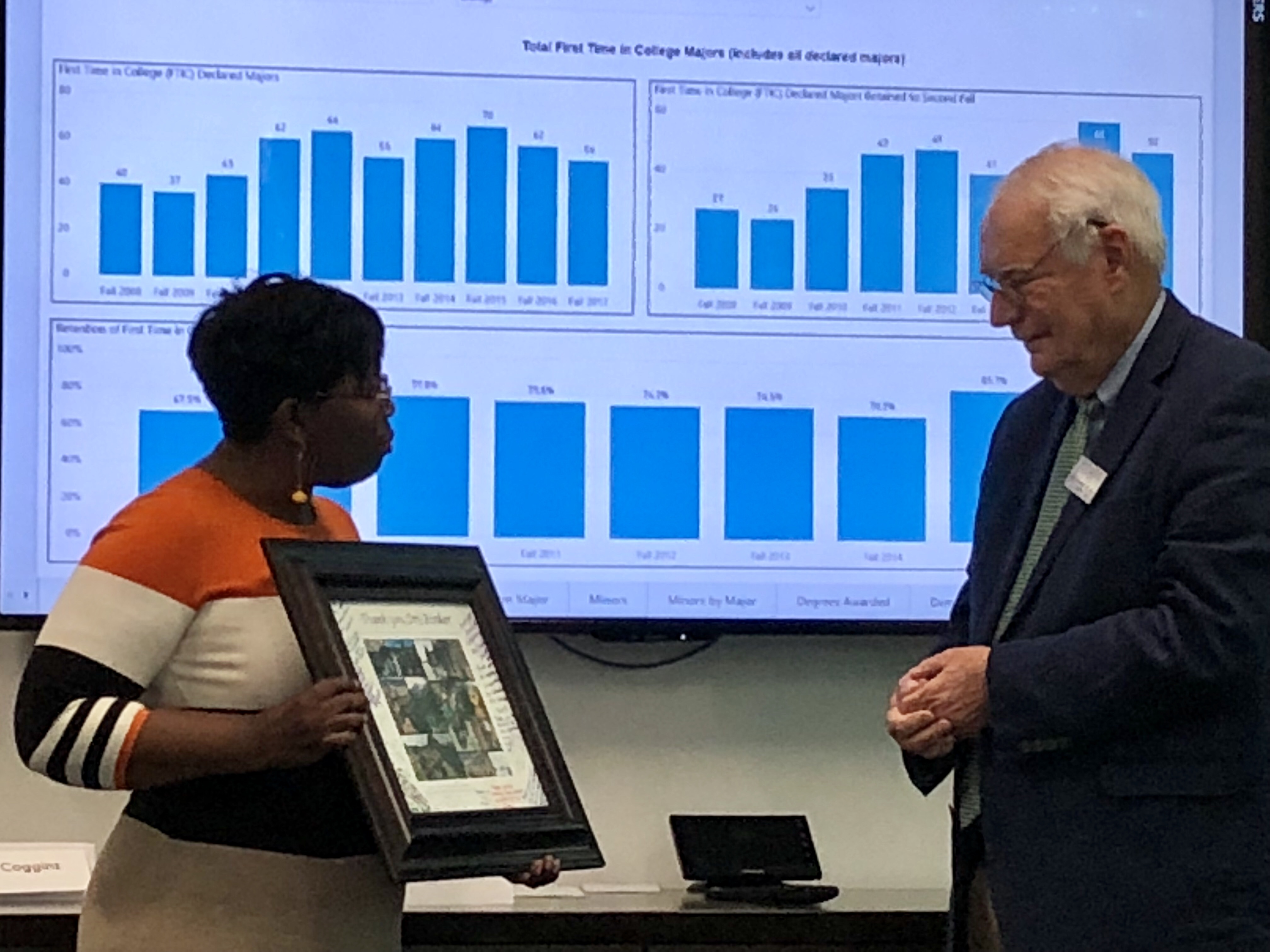
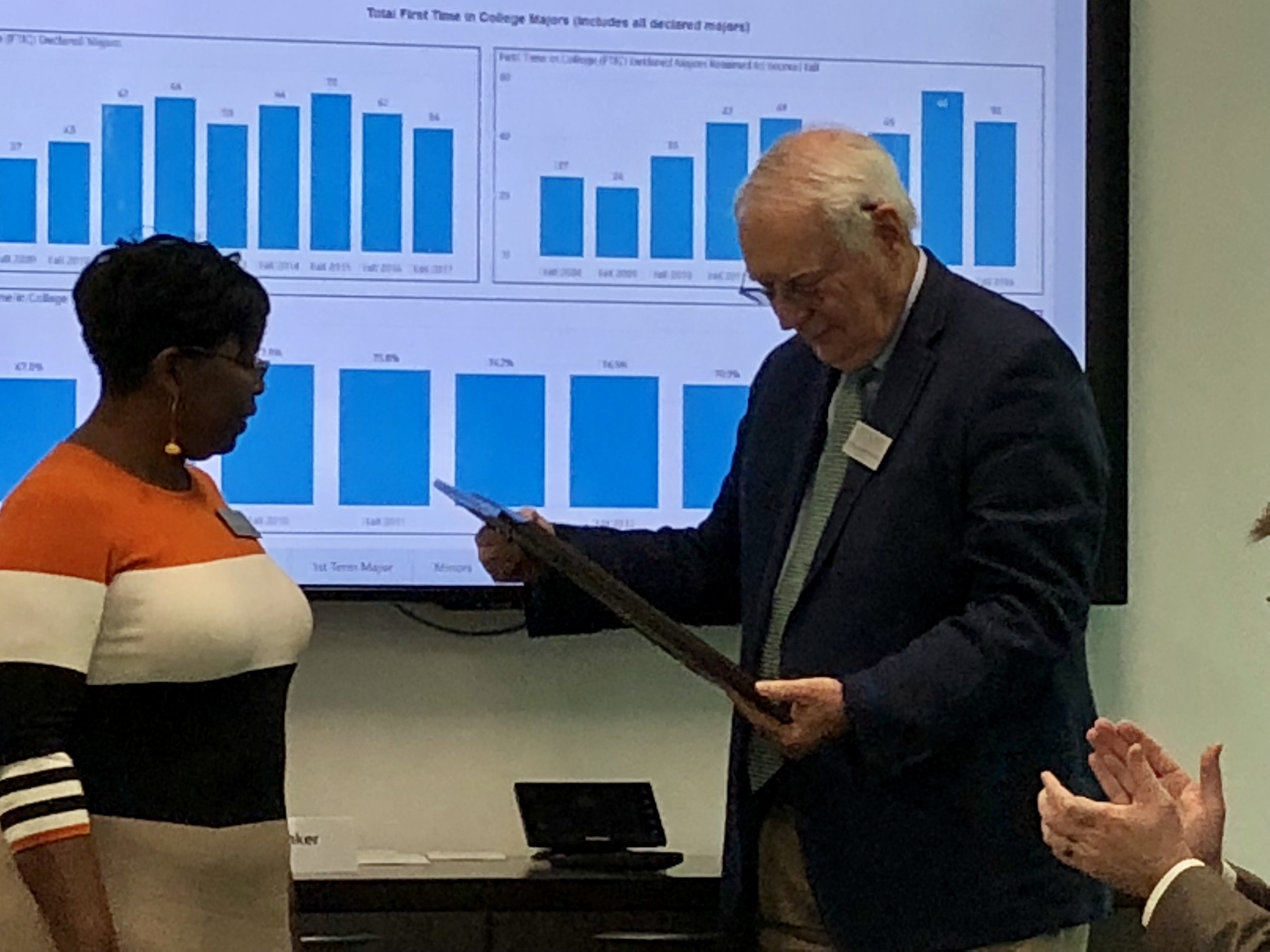
Dr. Rosalie Richards, associate provost for faculty development, presented this recognition on behalf of WORLD: The David and Leighan Rinker Center for International Learning.
A Once In a Lifetime Educational Experience
My junior year abroad, as part of Stetson University’s program in Freiburg, Germany, will always mark one of the best years of my life.
I was in Berlin in November 1989 with my fellow Stetson classmates, just days before the Berlin Wall fell and German reunification took place. Also, the German national soccer team won the World Cup in 1990, where I attended two of the team’s games in Milan, Italy. However, the highlight of my stay in Germany was taking a glider plane ride over the majestic Black Forest.

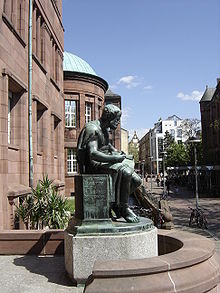
Located in the southwestern corner of Germany bordering Switzerland and France in the Black Forest, Freiburg boasts something that no other German city has – the most sun days per year in Germany. The city’s history, which dates back to the 11th century, is evident in its historic buildings, narrow cobblestone streets and of course, Muenster (Cathedral).
It was not until I arrived in Freiburg that I found that of the roughly 300,000 inhabitants, more than 100,000 were students at “The Uni”, the name its students affectionately refer to Albert-Ludwigs-Universitaet Freiburg. Yet, I feel the advantage Freiburg has over any large university in the US is its global reach and cultural diversity in attracting international students from 120 nations due to its geographical location and top-notch academics. In 2012, Freiburg Universitaet was ranked the best German university.
The best thing that the Freiburg program taught me was to have a real dialogue on different cultural and political ideas with Germans, Iranians, Turks, etc., while at the same time being the best ambassador I could for my country in educating students from other nations about the equality, individualism and private free enterprise that makes the US truly great.
Surprising to me was that my German major played more of a role than my political science major in landing my first job with a German commodities company in Manhattan in 1991. With this global corporation, Ruhrkohle Trading, I travelled the world continuing to build on the lessons I learned at Freiburg Universitaet in respecting other viewpoints and cultures. This greatly assisted in my successfully negotiating with foreign cultures across the globe, Brazil, China, Japan, South Africa, etc. in the trade of seaborne cargoes of natural resources.
I have worked for three companies, Ruhrkohle Trading, Evolution Markets and Wood Mackenzie, for 12 years in Manhattan as well as three years for a subsidiary of ArcelorMittal in Baltimore. The remainder of my career has been spent in home-based trading or advisory commodities businesses for global financial firms.
It is my belief that every student should take advantage of a semester or year abroad as part of their tertiary education in order to gain better linguistic skills and more importantly, a better understanding of foreign cultures and how other countries operate. Stetson University offers the best foreign exchange program available in unlocking this invaluable educational experience – Freiburg.
ABOUT THE AUTHOR
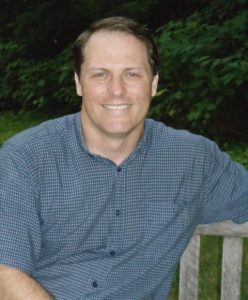
Markus Bates grew up in Darien, Conn. and earned a bachelor of arts degree in political science and German from Stetson University in 1991.
After earning his degree at Stetson University, Markus distinguished himself by leading operations for trading companies that resulted in becoming the largest exporter of steel raw materials from China for close to a decade. Overall, he has held senior executive positions in the trade of global commodities for 13 years. In 2011, he attained an ongoing education graduate degree in accounting from Sacred Heart University.
Today, Markus lives in Ridgefield, Conn. with his 13-year-old son and runs his own management consulting firm. He enjoys coaching youth sports, skiing and swimming.